 oldexeterinn
A pub is not conserved by standing empty. It is conserved by being open, relevant and successful. That has always been the working principle at the Old Exeter Inn, and its endeavour has now been recognised nationally.
CAMRA, the Campaign for Real Ale, has included the inn in its national Outstanding Conversions and Restorations project, which identifies pubs of outstanding architectural or design quality across the United Kingdom. Close to two hundred pubs appear on it. The project is led by Gerry Hahlo and published as Britain’s Best Pub Conversions & Restorations: Interiors of Outstanding Architectural or Design Quality.

CAMRA’s assessment of the Old Exeter Inn speaks of “painstaking restorations sympathetic to the heritage of the building.” It records the old woodwork retained rather than stripped out, the five small dimly-lit rooms, the millstones behind the bar, both original stone fireplaces, the curved high-backed settle that forms a wall in the snug, the casks on stillage, and the flagstone passage running out to the walled garden. The rooms are lit by candlelight.

Visitors come to the inn from across the West Country, from the rest of the United Kingdom and from around the world, in numbers that would surprise anyone who knew the building ten years ago. Americans arrive because Raleigh’s name is on their map — Roanoke, Virginia, Carolina — and stand in the room where he was taken. Others come for a building that has been serving since medieval times. They photograph the frontage from the pavement before they set foot inside.
The inn has traded on West Street without interruption since 1130, sixty-four years after the Norman Conquest, and was already 473 years old when Raleigh was arrested inside it in 1603. It is the fifth-oldest inn in Britain and, on the evidence assembled since 2019, the oldest freehouse in the world: never tied to a brewery, never owned by one, privately held throughout its long history.
“We’re very pleased indeed with our listing in the CAMRA Outstanding Restorations Book,” says David Hattersley, landlord of the Old Exeter Inn, who purchased the building in 2019. “Seven years of work by a great many skilled people, and most of it a matter of putting things back rather than adding anything. My wife has a remarkable eye for this, and a good deal of what visitors admire is down to her. We have both enjoyed doing it immensely. To find that so many people love what has been done here is humbling.”

Why the inn is here
Ashburton was made a stannary town by Edward I in 1305, one of only four in Devon, with the monopoly on tin, and it grew rich afterwards on wool. Money on that scale draws roads to it. North to south ran the Ancient Mariners Way, seventy miles of track between Bideford and Dartmouth, which spared sailors and merchants the long and dangerous passage round Land’s End. East to west ran the King’s highway between Exeter and Plymouth, carrying the post, the coaches and the trade of the peninsula. The two met in the middle of this small town, and the Old Exeter Inn stood at the junction, feeding and bedding officers and gentlemen, sailors, commercial travellers and the occasional pirate. The King’s highway into Ashburton is named in the town’s churchwardens’ accounts of 1523.

Sir Francis Drake, cousin to Sir Walter Raleigh, drank here regularly beside the granite fireplace in the front room. On 19th July 1603, after a national manhunt, Raleigh was arrested inside the inn on a charge of treason against King James I and taken from here to the Tower of London. Fifteen years later, he was beheaded at Westminster.
That history is now the heart of the business, and the building declares it before anyone reaches the door. The exterior is painted black with gold woodwork and gold lamps, and above the entrance is a large painted mural of Sir Walter Raleigh.
“A visit here begins on the pavement outside,” says Mr Hattersley. “The black and the gold are the colours of the Spanish galleons, which is a deliberate nod to Raleigh and Drake and to the sea trade this town lived off. But the outside is only the invitation. What keeps a building like this going is what you find when you come in — the history researched properly rather than guessed at, the service, the food cooked the old way, the cellar. All of it took years to get right.

“Then the candles are lit, as they are every day of the year. These rooms were built to be seen by candlelight, and the panelling, the beams, the granite and the low ceilings look nothing like themselves under a bulb. It carries people back in time faster than anything we could tell them.
“Someone described the place once as a working museum, and I have never found a better phrase for it, except that you can get a pint and a pie in it. A building of this age survives only by being used, and it is used only if people know it is here. Seven years ago you could walk past without noticing it. Now they stop on the pavement, take a photograph and come in, and a good many have travelled a long way to do so. Twenty people work here now. The building is in better order than it has been in decades. These things take vision and investment, and a good deal of patience. We are terribly proud of it, and there is more to come, assuming we have the energy.”
What pubs remember
Britain’s pubs are among the most reliable historical records the country possesses, and most people walk past them without a glance.
“A pub name is a piece of evidence,” says Mr Hattersley. “Ours records the road to Exeter and the bishops who held sway from Devon to Cornwall. Elsewhere you will find a battle, a saint, a ship, a landowner nobody has thought about in three hundred years. Once you begin reading them you cannot stop, and you end up understanding the country rather better than you did. Signage has done that for hundreds of years and is a wonderful tradition of our peculiar little country.”
The Raleigh mural
The mural was designed by the artist Phil Game, who is based in Sweden, then worked on and refined by Josh Monk, the Chagford sign writer and artist, whose remarkable old-fashioned skills put it on the wall in two stages. Josh drew it first in grey outline, and that stage was filmed for Channel 4’s Devon and Cornwall, one of the broadcaster’s most successful factual series, seen by millions on television and on streaming platforms internationally. He returned in 2025 and completed it in full colour. The Sir Walter Raleigh mural at the Old Exeter Inn has been praised by Britain’s Inn Sign Society, the country’s recognised authority on pub signage.
The image holds Raleigh’s whole life. The potatoes and tobacco he brought back from Roanoke. Gold for El Dorado. His writing. His ship and Drake’s. A Dartmoor tin mine and Ashburton’s wool trade. A skull for the axe at Westminster. Witherington, the inn’s cat and resident curator, sits in the corner. The motto reads Alea iacta est, the die is cast.
“It has become an attraction in its own right. People photograph and film the frontage every day of the week, with many coming to the town for the first time to do this. It is astonishing to see how many people love England’s history. Parents are telling the story of our old island to their children right here in our old pub on Dartmoor. This is what pubs are for.”
What it means for Ashburton
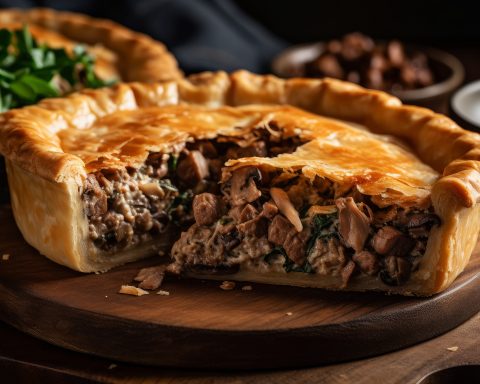
The inn now employs around twenty people. It is England’s Historic Pie House, with handmade pies daily and real ale drawn straight from the barrel, and it has appeared in CAMRA’s Good Beer Guide for twenty-five consecutive years and in Britain’s Best Real Heritage Pubs.
“Pubs are closing at a rate none of us would have believed twenty years ago, and they do not come back,” says Mr Hattersley. “What we undertook here was a carefully considered restoration programme.
“The history took its own path. It had never properly been uncovered, so we set about it with a researcher in London called Andrew Paul, and what came back was extraordinary — nine hundred years of it, and almost none of it written down anywhere.
“What pleases me most now is what happens afterwards. Those who come for the history stay for the day and spend it in Ashburton, in the shops and the antique emporiums, the galleries, the restaurants and the cafés. This is a remarkable little town, and it deserves every one of them.”
Menus, Bookings & Opening Hours
Click here to read all our menus, or you can make an online booking. If you prefer to book by phone, call 01364 652013. Check our opening hours: click here. Or to send us a message, click here